The Architecture
of Self-Deception
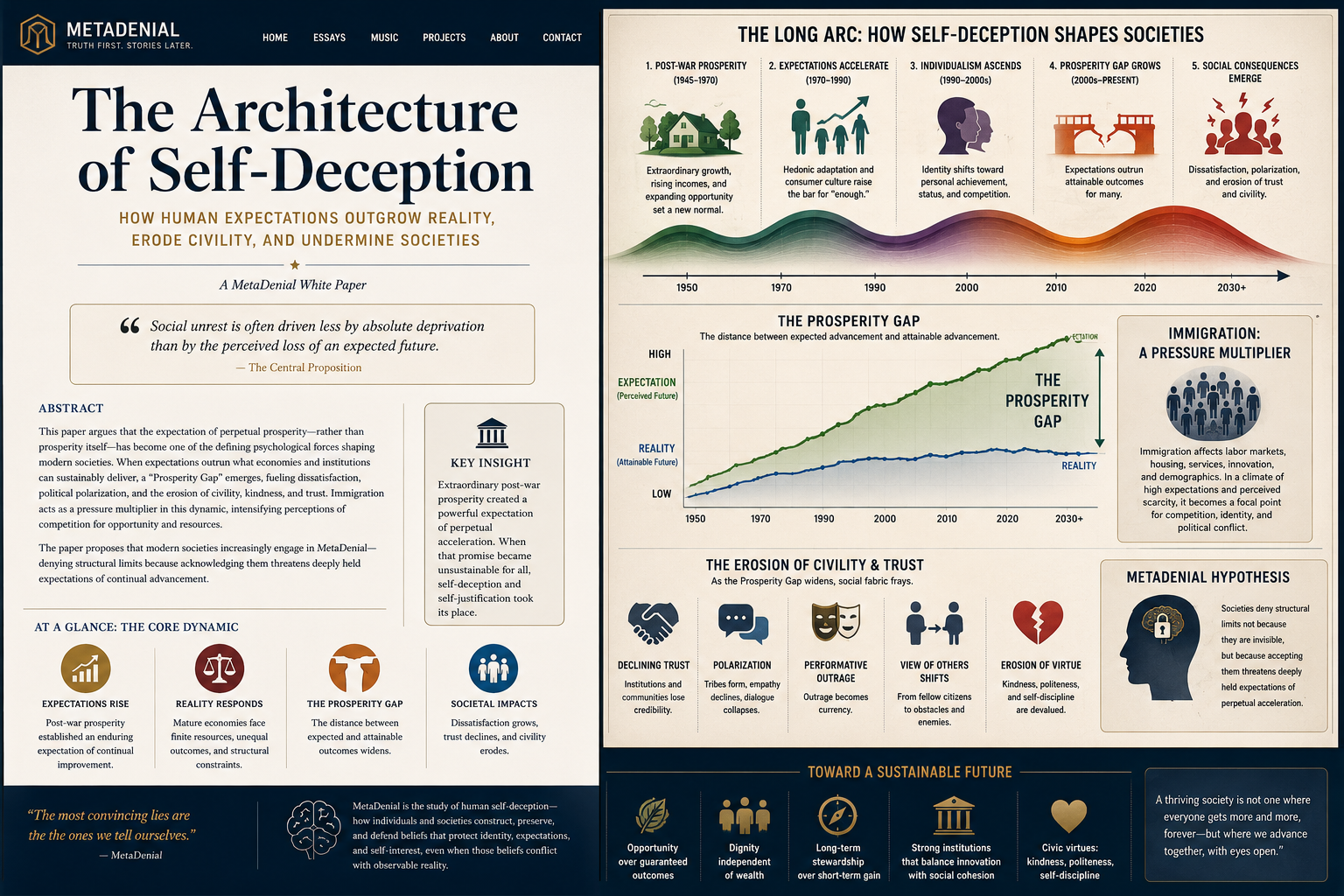
Abstract
The unprecedented prosperity experienced by the United States following World War II fundamentally altered not only economic conditions but also societal expectations. For the first time in modern history, multiple generations grew up assuming that increasing comfort, wealth, opportunity, and personal advancement were not exceptional achievements but the normal trajectory of life.
This paper argues that the expectation of continual acceleration—not prosperity itself—has become one of the defining psychological forces shaping modern American society.
While the post-war economic engine successfully elevated living standards for millions, it also created an implicit social contract: each generation would continue to experience increasing material success. As economic systems matured and structural limits emerged, this expectation became increasingly difficult to fulfill universally.
The resulting gap between expected prosperity and attainable prosperity—the Prosperity Gap—may help explain growing dissatisfaction, declining trust in institutions, political polarization, and the erosion of civility. Rather than being driven primarily by declining living standards, modern discontent may be fueled by the perceived loss of an expected future.
This paper synthesizes established research from psychology, economics, sociology, and political science while proposing a new conceptual framework for understanding why affluent societies can simultaneously become increasingly dissatisfied.
1. The Greatest Economic Expansion in Human History
The decades following World War II represented one of history’s most remarkable periods of sustained economic expansion.
Numerous structural conditions converged: industrial dominance, inexpensive energy, expanding manufacturing, the GI Bill, interstate highways, suburbanization, rapid productivity gains, favorable demographics, and increasing global trade.
For millions of Americans, prosperity appeared almost inevitable. Each generation generally expected larger homes, higher incomes, greater security, improved healthcare, better education, more consumer choice, and earlier retirement.
The post-war economy delivered many of these expectations with remarkable consistency. This success fundamentally reshaped cultural psychology.
2. The Birth of the Expectation Economy
Economic growth gradually transformed into psychological expectation.
Behavioral science describes the tendency to rapidly normalize improvements in living conditions as hedonic adaptation. Yesterday’s luxury becomes today’s baseline. Success ceases to generate lasting satisfaction because expectations continually reset upward.
Applied across an entire society, this process produces what this paper calls the Expectation Economy: a society in which future satisfaction depends less upon absolute prosperity than upon continual improvement beyond the present.
3. When Prosperity Became Identity
Beginning in the 1970s, several cultural changes accelerated the shift toward individual attainment: deregulation, investment culture, expanding consumer credit, personal branding, entrepreneurial identity, technological innovation, digital commerce, and social media.
Economic achievement increasingly became synonymous with personal worth.
The question subtly shifted from “How are we doing?” to “How am I doing compared with everyone else?”
Competition gradually replaced shared advancement as the dominant cultural narrative.
4. The Mathematics of Impossible Expectations
Here lies the paper’s central paradox.
Every individual may aspire to become wealthier. Yet not everyone can simultaneously occupy the highest economic tier. Competitive economies necessarily generate unequal outcomes. Resources remain finite. Capital concentrates. Opportunities vary.
This does not indicate failure. It reflects structural reality.
The contradiction emerges when an entire society expects exceptional outcomes to become universal outcomes. The expectation itself becomes unsustainable.
5. Relative Deprivation
People rarely evaluate prosperity in absolute terms. Instead, they compare themselves with neighbors, coworkers, previous generations, media portrayals, and cultural ideals.
Social science describes the resulting perception of disadvantage as relative deprivation.
A person can enjoy historically unprecedented comfort while simultaneously believing that they are falling behind. Expectation becomes more powerful than circumstance.
The Prosperity Gap emerges precisely here: the distance between expected personal advancement and realistically attainable advancement within a mature economy.
6. The Political Consequences
When expected trajectories slow, political systems become increasingly unstable.
Throughout modern American history, different movements have interpreted this gap differently. Civil-rights movements demanded equal participation in prosperity. Anti-war movements questioned national priorities. Economic conservatism emphasized renewed growth. Labor movements resisted displacement. Populist movements promised restoration. Progressive movements emphasized structural inequality.
These movements differ profoundly in philosophy. Yet they frequently arise from a common perception: the expected future has been interrupted.
7. Immigration as a Pressure Multiplier
Immigration occupies a uniquely sensitive position within the Expectation Paradox because it intersects with economics, demographics, identity, labor markets, and national values simultaneously.
Immigration can contribute to entrepreneurship, labor-force growth, innovation, and demographic renewal. It can also increase localized demand for housing, schools, infrastructure, healthcare, and public services. Its effects vary by region, industry, skill level, policy design, and time horizon.
Within the framework of this paper, immigration is best understood as a pressure multiplier rather than a singular cause of dissatisfaction.
When large segments of a population already believe their expected path to prosperity has narrowed, additional competition—whether perceived or actual—for jobs, housing, educational opportunities, or public resources can become psychologically amplified. Immigration then becomes one of several visible issues through which broader anxieties about opportunity are expressed.
Some citizens view immigration primarily as an engine of economic vitality and long-term national strength. Others view it as increasing competition within systems they already perceive as failing to deliver on long-held expectations.
The intensity of immigration debates may therefore reflect not only disagreement over border policy, but disagreement over a deeper question: Who should participate in the opportunities created by a prosperous society, and under what rules?
Within the Expectation Paradox, immigration serves as a catalyst that intensifies political conflict when expectations exceed the perceived capacity of society to satisfy them.
8. When Competition Replaces Community
If prosperity becomes the primary measure of success, obstacles to prosperity increasingly become viewed as personal threats.
Neighbors become competitors. Citizens become rivals. Disagreement becomes obstruction.
The social costs may include declining trust, increasing hostility, political tribalism, reduced empathy, performative outrage, moral absolutism, and greater tolerance for cruelty toward those perceived to stand in the way of individual gain.
9. Whatever Happened to Self-Discipline?
Many philosophical traditions identify three foundational civic virtues: kindness, politeness, and self-discipline.
These qualities often require individuals to moderate immediate self-interest for the benefit of long-term relationships and shared institutions.
The pursuit of prosperity does not inherently conflict with these virtues. Disciplined work, innovation, and ambition have been central to economic progress.
The tension arises when prosperity becomes the dominant measure of personal value and success is increasingly perceived as a zero-sum competition. Under those conditions, other people may be viewed less as fellow citizens and more as competitors or obstacles.
In such an environment, kindness may be interpreted as weakness, politeness as inefficiency, and self-discipline as an unnecessary restraint on maximizing personal advantage.
The concern is therefore not wealth itself, but the gradual reordering of civic priorities. If the expectation of continual individual advancement eclipses the values that sustain cooperation, the social fabric may weaken even as material abundance continues to grow.
10. Denying Limits
The central contribution of this paper is the proposal that affluent societies increasingly deny structural limits because acknowledging those limits threatens a deeply embedded expectation.
The denial is not primarily economic. It is psychological.
Modern society continues to act as though everyone can become affluent, growth can accelerate indefinitely, consumption has no ceiling, technology will always rescue expansion, and every generation is entitled to more than the last.
These beliefs are understandable. They are also increasingly difficult to reconcile with finite resources, demographic shifts, mature economies, environmental constraints, fiscal constraints, and the unequal distribution of opportunity.
This paper calls that phenomenon MetaDenial: the collective tendency to deny structural limits because doing so preserves the psychological expectation of perpetual acceleration.
Conclusion
The central argument of this paper is intentionally limited.
It does not claim that prosperity is harmful. It does not argue against capitalism, immigration, technological progress, or ambition.
It proposes that the expectations created by extraordinary historical success may now exceed what any mature society can sustainably provide for everyone simultaneously.
The greatest challenge facing affluent democracies may therefore be psychological rather than strictly economic.
Social unrest is often driven less by absolute deprivation than by the perceived loss of an expected future.
If that proposition is correct, rebuilding durable societies will require more than increasing gross domestic product or expanding consumption. It will require renewing the civic virtues that allow individuals to pursue ambition without abandoning the common good.
Future Research
This framework invites empirical testing of the Prosperity Gap using historical measures of expectations, subjective well-being, mobility, wealth concentration, and institutional trust.
Comparative studies could examine whether societies with different post-war trajectories exhibit similar cycles. Evolutionary psychology may help test whether continual resource acquisition is an adaptive mechanism that becomes maladaptive under conditions of abundance.
Additional work should examine technological disruption, artificial intelligence, automation, immigration policy, housing scarcity, environmental limits, and the role of civic institutions in either amplifying or moderating the Expectation Paradox.